

The Sports Minister Is Dead Wrong! - Winning Matches Is Not Governance
2026-03-12 - When the Minister of Sport, Arts and Culture, Gayton McKenzie, stated in an interview broadcast on Metro FM’s Sports Night Amplified with Andile on 11 March 2026, he made a bold assertion: that South African football is currently enjoying its “best period ever”. He couldn't be more wrong!
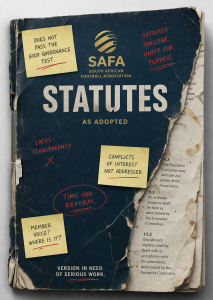
Fix the Rules Before the Vote - A Warning on SAFA’s Elections
2026-02-03 - Elections are commonly understood as the heartbeat of democracy. Yet history, law, and political philosophy warn us that elections, when conducted within a fundamentally flawed constitutional framework, can become instruments of entrenchment rather than renewal. In my Sociology 101 class, I learned that Hannah Arendt and Max Weber cautioned against the manipulation of legality to clothe domination in the appearance of legitimacy. It is precisely this danger that confronts South African football today.
Distinguishing Between Interference and Intervention in Football Matters
2025-11-15 - In Part Two of a 2-part series on FIFA's attitude on government involvement in football affairs, this article delves deeper into the conditions under which FIFA will react to government intervention in football matters. It dissects the meaning of "undue influence" and attempts to clarify the distinction between "interference" and "intervention", highlighting what may be acceptable to FIFA, emphasizing support versus control.

Government Interference: Case Studies, and Implications for South African Football
2025-10-17 - In Part One of a 2-part series on FIFA's attitude on government involvement in football affairs, this article examines Article 19 of the FIFA Statutes (and related articles), explores international examples (Namibia, India, Zambia, Sierra Leone, etc.), considers what the UK has done by way of oversight and regulation (without running afoul of FIFA), and reflects on how SAFA’s governance might be reformed in light of these precedents.

A Blueprint to Stabilize Football Legends Structures
2025-10-13 - For many years, the South African Masters and Legends Football Association (SAMLFA) has been dysfunctional, run by a two-man show that failed to convene a congress for 12 years (and counting); failed to produce a financial report; and failed to issue an annual activity report. The leading roles (President and CEO) were occupied through backdoor "elections" and without legitimate or proper appointment procedures. When pressed by SAFA to convene a congress in 2019, they failed miserably and has failed ever since to make another attempt.

FIFA World Cup 2026 - FIFA’s Sanction on Bafana Bafana Will Not Be Overturned on Appeal
2025-09-29 - FIFA has spoken, and the verdict is brutal. South Africa’s national team has been slapped with a CHF10,000 fine, docked three points, and stripped of the two goals scored against Lesotho — with a three-goal penalty added to boot. The mathematics is stark: Bafana Bafana’s goal difference has been cut by five, leaving us with +3 while Benin, our main rival in Group C, now sit on +4, pushing them to the top of the log.

FIFA World Cup 2026 - Analysis of the Teboho Mokoena Saga
2025-09-09 - This is a response to an article published online in Sunday World on 9 September 2025, authored by Kgomotso Mokoena. The article quotes an anonymous SAFA source who assured the reporter that Bafana Bafana will not lose points following the alleged unlawful fielding of player Teboho Mokoena in a match against Lesotho on 21 March 2025. South African beat Lesotho 2-0 in a 2026 FIFA World Cup Qualifier.

FIFA World Cup 2022 - Analysis: South Africa vs Ghana Complaint (2021) Compared to South Africa vs Senegal (2016/7) Complaint
This analysis digs into SAFA’s failed attempt to overturn FIFA’s order to replay the match against Senegal, laying bare how the association was tripped up by its own shortcomings: a failure to grasp the shifting legal terrain and a startling inability to keep pace with crucial amendments to the 2018 and 2022 FIFA World Cup Regulations and the FIFA Disciplinary Code.

Suspensions in South African Football: What Is Legal?
Suspensions of individuals are the most common form of discipline meted out by executive committees around the country – yet, no such authority existed anywhere in the SAFA Statutes before March 2022 or the SAFA Standard Statutes to date. It must be clearly understood that the pre-2022 versions of the SAFA Statutes, Rules and Regulations made no provision for a person to be suspended by any executive committee. Article 70 of the 2018 SAFA Statutes drew a firm boundary around the types of sanctions that could be imposed on persons that fall under the jurisdiction of the Association.

Why Do Otherwise Rational People Display Cognitive Dissonance on Israel?
2025-08-14 - The famed Israeli historian, Ilan Pappé, recently remarked that there are people in this world who are quite sophisticated politicians, journalists, academics and other intellectuals whom one would respect when they talk or present a topic but who parrot the Israeli script without any criticism and without applying the intellectual rigor they would apply to any other subject that they would analyze. Pappé further stated that they would degrade themselves as thinkers and researchers by supporting Israel's genocidal policies and behaviour and even willing to undermine the international legal system and other rules in support of that.

Inside the Kingdom of SAFA: Power, Patronage, and Paranoia
2025-07-20 - Picture this: a football federation that talks democracy but walks dictatorship. A leadership so allergic to accountability it might as well ban the word itself. And a governing structure that could make even banana republics blush. If the first article exposed the money that did not reach its destination and the promises broken, this follow-up tells the deeper, more dangerous story — how power, paranoia, and patronage have captured South African football, turning SAFA from a sporting body into something resembling a fiefdom. Welcome to the Football Republic of SAFA — where democracy goes to die, and football is just the opening act.

Reimagining Football Leadership -- A Formula for Organizational Success
2025-06-15 - In the ever-evolving ecosystem of football, much of what determines long-term success happens off the pitch. Stadiums may be where matches are won, but it is within boardrooms, development offices, and training centres that the foundations of greatness are laid — or squandered. As someone who has observed and participated in the highs and lows of football administration, I have come to believe that sustainable organizational success must be designed with intent, not left to chance. To help chart a path forward, I offer a model I call the Organizational Success Formula, a framework specifically crafted for football bodies, federations, and clubs that want to rise above mediocrity and prepare for a future built on excellence.

The House Is Burning -- And SAFA Is Playing With Petrol
2025-07-03 - In this explosive exposé, we unpack the full extent of SAFA's dramatic collapse — from the catastrophic failure to renew Banyana Banyana’s flagship sponsorship with Sasol to shocking revelations made before Parliament’s Portfolio Committee on 3 June 2025. The article reveals a toxic culture of mismanagement, lies, and gaslighting at the heart of South African football. The article examines how SAFA’s leadership has crippled the organisation through reckless financial decisions, denial of basic support to Regions and players, and the erosion of democratic governance. This is not just a sports governance issue; it is a national scandal demanding immediate intervention. [condensed version published in Sunday World newspaper on 13 July 2025]

The Pathology of Racism: South Africa and the Global Condition
2025-07-20 - Racism is often understood as prejudice, discrimination, or antagonism directed against someone of a different race. But to fully grasp its destructive power, we must understand racism not merely as an attitude or a policy — but as a pathology. Like any disease, racism has an origin, spreads, infects systems, and leaves deep scars on both its victims and its hosts. Nowhere is this truer than in South Africa, a country that institutionalized racism through apartheid, yet continues to wrestle with its legacy decades after its formal end. However, South Africa is not alone. The same pathology manifests across the globe in different forms but with disturbingly similar effects.

A Satirical View of the "Disgruntled" and "Regime Change" Labels
2025-05-15 - Apparently, anyone who dares to question the noble lords of the South African Football Association is immediately transformed into a "disgruntled" individual, wandering the wastelands of bitterness, clutching a scroll of complaints. Or worse, they are accused of seeking that dark and sinister art known as "regime change" – a term normally reserved for world-shaking coups, but here, it applies to anyone suggesting that perhaps governance could be, you know, better.

Thoughts on the End of Reason, Idealism, and Critical Thinking
2025-05-20 - This essay is inspired by my observations of the shifting global geopolitical tides: Hot wars and trade wars; global shifts to the right; the ANC’s difficulty in shaking the service delivery curse; the rejuvenation of sovereignty and Pan-Africanism in the Sahel region of Africa; and the re-balancing of the global political economy with the emergence of the BRICS alliance signals a seismic shift, where nations and alliances are fluid, some reacting to their reduction of power in unpredictable ways as the shift from reason to populism demonstrates.

The Importance of Calculating the Net Present Value of a Football Club: Building Stability and Financial Success
2025-05-13 - This article delves into the significance of calculating the Net Present Value (NPV) of a football club, amongst other key metrics that shape the success of the club, as a cornerstone of economic strategy. In the world of modern football, financial success and sustainability are as critical as on-field performance. Running a football club effectively requires a nuanced understanding of various economic criteria that collectively ensure stability and long-term growth. From revenue generation and fan engagement to debt management and sustainability practices, these factors form a comprehensive framework for evaluating a club’s financial health.

SAFA: A Case Study in Leadership Failure and Institutional Decay: The Sasol Women’s League Debacle
2025-03-15 - The South African Football Association (SAFA) is in the throes of a governance crisis that threatens not only its credibility but also its very existence. The recent debacle involving the Sasol Women’s League clubs — unpaid prize monies, withheld travel subsidies, and the demand for registration fees despite these arrears — is symptomatic of a deeper malaise. This crisis is not merely financial; it is a crisis of leadership, accountability, and ethical governance. The association’s leadership, seemingly oblivious to the nuances of sound governance, continues to make decisions that are not only flawed but also legally and morally indefensible. The consequences of these actions are far-reaching, and the broader implications for SAFA and South African football as a whole are dire.




SAFA Ex-CEO Outlines Bafana Problems
2021-04-27 - Bafana Bafana’s failure to qualify for the 2021 African Cup of Nations Cameroon has created the perfect storm for the South African Football Association (SAFA). SAFA’s legendary poor governance structure and a sycophantic leadership core who has decimated its technical structures, has left it adrift in the proverbial rough seas of world football.
Originally published in iDiski Times 27 April 2021
How Power is Abused: The Pitfalls of Imperial Leadership
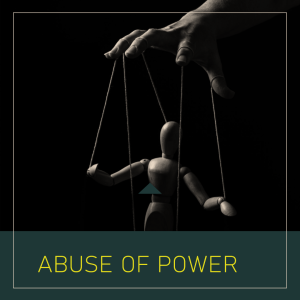
2023-05-22 - Leadership, by definition, is the act of guiding and directing a group of people towards a common goal. This requires a certain level of authority and power in order for the leader to effectively execute their duties and to avoid assuming an imperial posture in their attitudes toward others around them and thereby abusing their powers. This abuse of power is a well-documented phenomenon that has been studied extensively by psychologists, as well as philosophical and behavioural scientists.
By Dennis Mumble

SAFA's Exco is the Largest in the World
2023-05-17 - A comprehensive survey of the sizes of football association executive committees on the African continent reveals that the average size of executive committees is 14 (fourteen). A snap survey of executive committees in North and South America and Europe also amounts to 14, with the largest exco being 22 (Russia, with the world's largest land mass). The German FA (DFB), which is Europe's largest football association, has only 15 executive committee members. The English FA has 12 executive committee members.
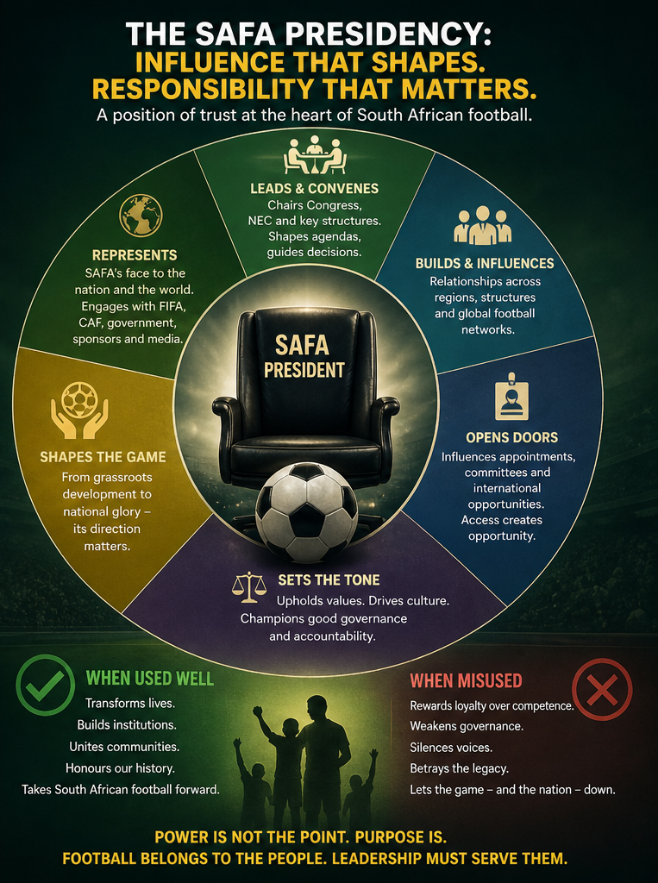
When Does FIFA Intervene in a Member Association?
2022-03-18 - FIFA’s Normalisation Committees – What Are They And How Do They Work? Out of FIFA’s 211 members, a significant number of associations have recent or current experience of normalisation committee intervention - By Dennis Mumble

Fact-checking SAFA's Response to the Mokoena and Mumble Reports
On 16 May 2020, SAFA circulated a response (hereinafter the SAFA Response) to two reports issued by two former CEOs Gay Mokoena and Dennis Mumble, wherein they (the two former CEOs) made serious allegations against the SAFA President for abusing his office. This document is a response to that circular sent to a few carefully selected SAFA Regions and is intended to inform SAFA’s members and other interested parties of the disinformation contained in the SAFA response.